Jaguar
Panthera onca
The jaguar is the largest cat in the Americas and the only living member of the genus Panthera there, ranging from Mexico to northern Argentina with its stronghold in the Amazon basin. Its bite is the strongest of any big cat relative to size, and it often kills by piercing the skull, letting it take caimans and armoured turtles that other predators avoid. Jaguars are listed as Near Threatened and have lost around half of their historic range.
Quick facts: Size 1.12–1.85 m body length, 0.45–0.75 m at shoulder · Lifespan 12–15 years in the wild, up to 20 in captivity · IUCN status Near Threatened
Print the fact sheet — a free one-page PDF for homeschool and classroom use
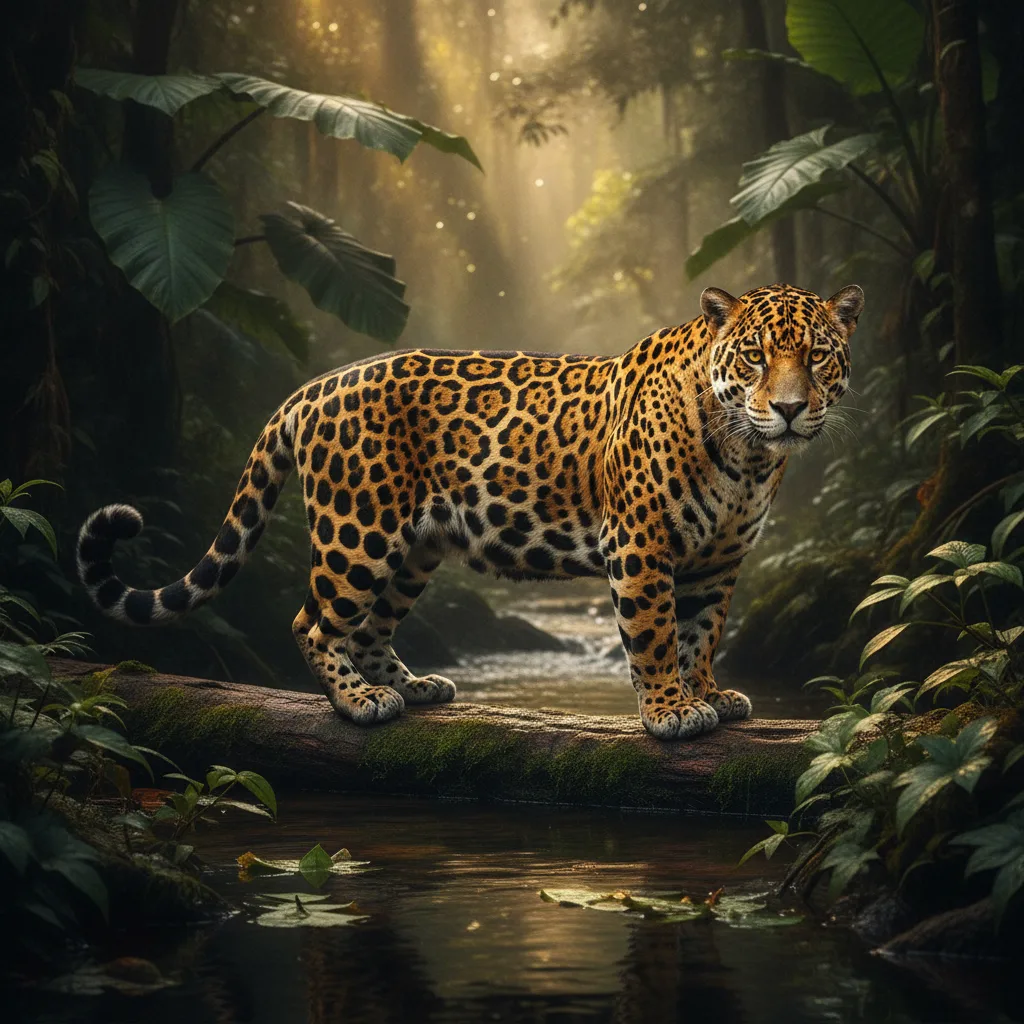
Jaguar at a glance
| Scientific name | Panthera onca |
|---|---|
| IUCN status | Near Threatened |
| Population | Approx. 64,000 |
| Population trend | decreasing |
| Weight | 100–158 kg |
| Length | 1.7–2.4 m |
| Lifespan | 12–20 years |
| Top speed | 80 km/h |
| Class | Mammalia |
| Order | Carnivora |
| Family | Felidae |
Need to know
- The jaguar is the largest cat species in the Americas and the third-largest in the world.
- Jaguars have the most powerful bite of any big cat, capable of piercing turtle shells and crushing mammal skulls.
- Their distinctive rosettes differ from those of leopards and can have a central black spot.
- Jaguars are excellent swimmers and often hunt in or near water.
- Historically, the jaguar's range extended up to the southwestern US, but is now substantially reduced.
About the Jaguar
The jaguar (Panthera onca) is the iconic spotted big cat of the Americas, revered by many indigenous cultures for its power and beauty. Once ranging from the southwestern United States to Argentina, jaguars are now primarily found in Central and South America, with the largest populations in the Amazon and Pantanal wetlands. As the apex predator in its ecosystem, the jaguar plays a crucial role in regulating prey species and maintaining ecological balance.
Jaguars are solitary, elusive, and predominantly active at dawn and dusk. They possess the most powerful jaws among big cats, using a unique killing technique: biting directly through the skulls of prey. Though often mistaken for leopards, jaguars are stockier, with broader heads and more complex spot patterns.
Physical characteristics
Size: 1.12–1.85 m body length, 0.45–0.75 m at shoulder. Weight: 45–158 kg, with males averaging 100 kg. Lifespan: 12–15 years in the wild, up to 20 in captivity.
- Robust build with short, stocky limbs
- Large, rounded head with exceptionally strong jaw muscles
- Distinctive rosette markings each with a central spot
- Tail short in comparison to body size
- Coat color varies from pale yellow to deep gold
Notable species
- Jaguar (Panthera onca) — Near Threatened. Dense tropical forests, flooded wetlands, dry woodlands, and riverine forests Regions: Amazon Rainforest, Pantanal, Cerrado, Gran Chaco, Atlantic Forest, Central America, southern Mexico.
- Central American Jaguar (Panthera onca centralis) — Endangered (regional). Forested lowlands, mountain forests Regions: Guatemala, Belize, Honduras, Nicaragua, Costa Rica, Panama.
- Pantanal Jaguar (Panthera onca palustris) — Locally stable. Wetlands, flooded grasslands Regions: Pantanal.
- Amazonian Jaguar (Panthera onca onca) — Near Threatened (regional). Dense humid tropical rainforest Regions: Amazon Rainforest, northern Bolivia, eastern Peru, western Brazil, southern Venezuela, eastern Colombia.
- Northern Mexico Jaguar (Panthera onca veraecrucis) — Critically Endangered (regional). Desert scrub, dry forests, mountainous regions Regions: Sierra Madre Occidental, Sonora, Sinaloa, Chihuahua, Arizona (very rarely crossing the US border).
Habitat and range
Original range: Ranged from southern United States (southwest) through Central America to northern Argentina
Current distribution: Now largely restricted to Central and South America, with the largest populations in the Amazon and Pantanal
Preferred environments: Tropical rainforests, Flooded wetlands, Gallery forests, Dry scrub forests, Savannas, Riverine and swampy areas
Regions: Amazon Rainforest, Pantanal, Gran Chaco, Atlantic Forest, Central America, southern Mexico, northern Argentina, Guianas, Cerrado
Where to see Jaguar
- Pantanal, Brazil — July–October (dry season). Best place for reliable wild jaguar sightings, often seen hunting along riverbanks
- Amazon Rainforest (Brazil/Peru) — May–September. Sightings are rare; look for claw marks and tracks along riverbanks
- Cockscomb Basin Wildlife Sanctuary, Belize — February–May. Home to the highest density of jaguars in Central America; elusive but tracks are common
Behavior and diet
Diet: Carnivorous; hunts over 85 species including peccaries, capybaras, tapirs, deer, turtles, caimans, fish, and sometimes livestock
Social structure: Solitary, territorial except during mating or when a female cares for cubs
Communication: Vocalizations (roars, grunts, mews), scent marking, scraping, and claw marking trees
- Kills prey with a powerful skull bite between the ears to pierce the brain
- Active in both day and night but prefers dawn and dusk (crepuscular)
- Often swims and hunts in water, unusual among big cats
- Will cache prey and return to feed over several days
Interactions with other animals
- Caiman (prey): Jaguars are one of the few predators capable of hunting full-grown caiman, using powerful jaws to crush the skull.
- Capybara (prey): A favored food source for jaguars in wetlands and riverine environments.
- Puma (competitive): Jaguars and pumas share territory; jaguars typically dominate and will outcompete or displace pumas where ranges overlap.
- Giant otter (competitive): Occasionally compete for fish and river prey, but rarely interact directly.
Conservation
IUCN Red List status: Near Threatened
Threats
- Habitat loss and fragmentation
- Poaching for fur and body parts
- Human-wildlife conflict (livestock predation)
- Prey reduction due to overhunting by humans
- Illegal trade
Conservation efforts
- Creation of protected reserves (e.g., Pantanal, Cockscomb Basin)
- Wildlife corridors to connect fragmented populations
- Anti-poaching patrols and law enforcement
- Livestock compensation programs to reduce conflict
- Education and community outreach
How to help
- Support organizations focused on large cat conservation
- Encourage responsible and sustainable land use in jaguar habitats
- Avoid buying products made from endangered species
- Promote ecotourism that benefits local communities and jaguar protection
- Educate others about the importance of jaguars in their ecosystems
Jaguar facts for kids
Jaguars are the biggest wild cats in the Americas. They have beautiful spotted fur and love swimming in rivers and streams. Jaguars are strong and fast hunters that help keep the rainforest healthy.
- Jaguars have spots called 'rosettes' with tiny black dots in the middle!
- They can swim really well and sometimes hunt for fish and turtles.
- Jaguars have super strong jaws—strong enough to bite through a turtle shell!
- Baby jaguars (called cubs) are born with their eyes closed.
- Sometimes black jaguars are called 'black panthers,' but they're really just jaguars with very dark fur!
Did you know? Did you know a jaguar's bite is so strong it can crush the skull of a crocodile?
Watch & learn
- Jaguar: Brazil's Top Predator - BBC Earth Documentary Segment — BBC Earth. Discover how the jaguar, Panthera onca, dominates the Brazilian wetlands in dramatic footage showing its strength and unique hunting techniques. This BBC Earth segment features breathtaking wild jaguar behavior in Pantanal.
- Battle of the Big Cats: Jaguar vs. Caiman - National Geographic Wild — National Geographic Wild. Watch the incredible moment as a jaguar takes on a caiman in the wild, showcasing its formidable hunting abilities. National Geographic Wild provides rare close-up coverage of this intense predator-prey interaction.
- The Secret Lives of Jaguars - Smithsonian Channel Feature — Smithsonian Channel. Go behind the scenes with wildlife experts tracking and studying jaguars in Central and South America. The Smithsonian Channel explores their elusive lifestyle using groundbreaking camera trap footage.
- Jaguar: The Amazon's Elusive Predator - PBS Nature Full Episode — PBS Nature. This PBS Nature episode offers a comprehensive look at the Jaguar's role in the Amazon's ecosystem, featuring remarkable footage and expert commentary on their survival challenges.
- Jaguar Territory: Protecting the King of South America - Nat Geo WILD — Nat Geo WILD. Follow conservationists as they work to protect jaguars and their habitats in South America. Nat Geo WILD highlights both the dangers jaguars face and their vital ecological importance.
Sources
Facts on this page are checked against these references. Follow them for the primary data.
- IUCN Red List — Conservation status, population trend and range assessment for Panthera onca
- Encyclopaedia Britannica — Reviewed encyclopaedia entry on the jaguar
- National Geographic — Articles, photographs and field reporting on the jaguar