Red Fox
Vulpes vulpes
The red fox has the widest natural range of any land carnivore, spanning the Northern Hemisphere from Arctic tundra to North Africa and, following introduction, Australia. It hunts small rodents with a characteristic high pounce and can hear a mouse moving under snow or grass. The species is Least Concern and thrives in cities as readily as in open country.
Quick facts: Size Head-body length typically 45–90 cm, tail 30–55 cm · Lifespan 2–5 years in wild, up to 14 years in captivity · IUCN status Least Concern
Print the fact sheet — a free one-page PDF for homeschool and classroom use
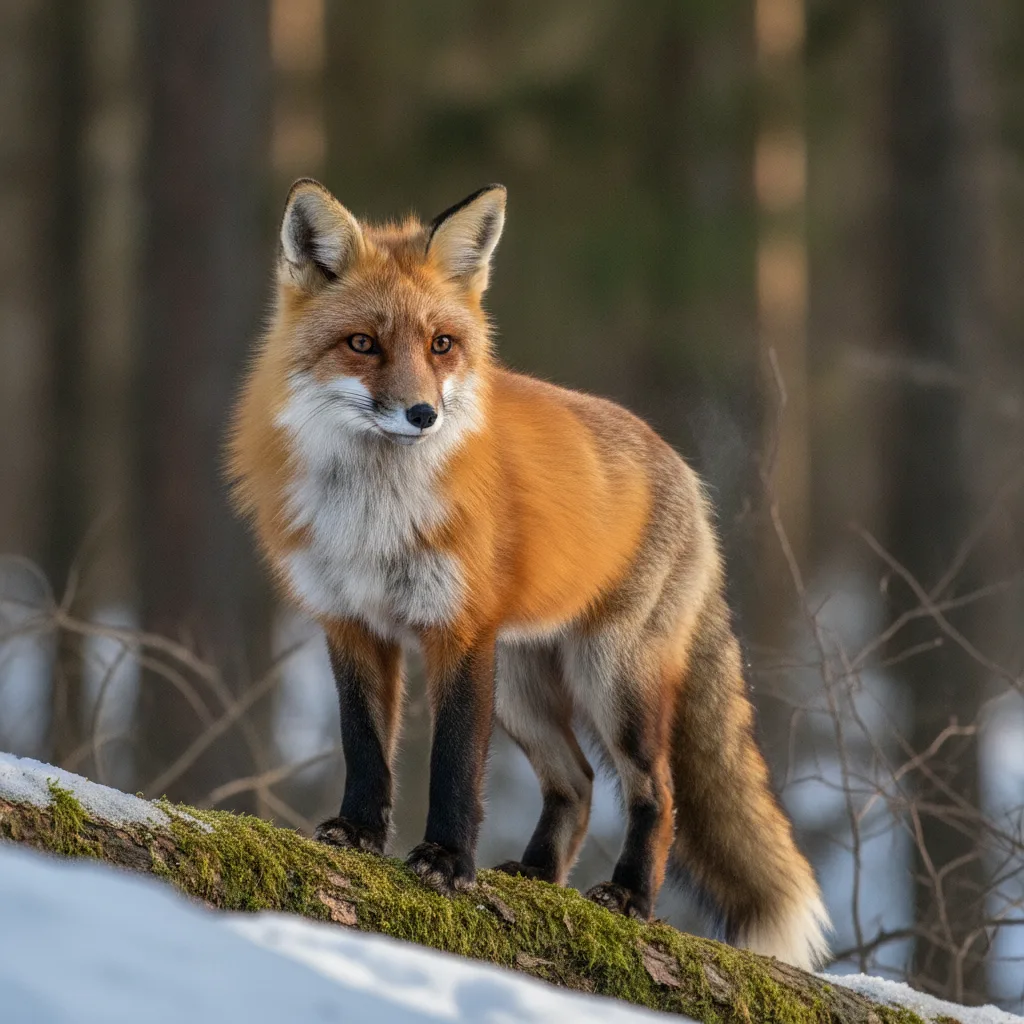
Red Fox at a glance
| Scientific name | Vulpes vulpes |
|---|---|
| IUCN status | Least Concern |
| Population | 7,000,000 - 30,000,000 |
| Population trend | stable |
| Weight | 5.5–15 kg |
| Length | 60–90 cm |
| Lifespan | 3–14 years |
| Top speed | 50 km/h |
| Class | Mammalia |
| Order | Carnivora |
| Family | Canidae |
Need to know
- The red fox is the most widely distributed wild carnivore on Earth.
- They adapt to environments from Arctic tundra to suburban gardens.
- Red foxes use over 20 types of vocalizations to communicate.
- Red foxes have exceptional hearing and can pinpoint prey under snow.
- They are famous for their intelligence and cunning in folklore.
- Red foxes have been introduced to Australia, impacting native wildlife.
About the Red Fox
The red fox (Vulpes vulpes) is one of the world's most adaptive mammals, thriving in diverse environments from remote tundra to bustling cities. Famous for its bushy tail, sharp face, and striking red coat, the red fox has spread across the Northern Hemisphere and thrives as both a wily hunter and urban survivor.
Red foxes use intelligence and keen senses to hunt small mammals, birds, insects, and even fruit. Their ability to exploit new environments has led to their success on nearly every continent, but also makes them controversial in places like Australia where they are an invasive species. Tolerant of cold, heat, cities, and wilderness, their adaptability is unmatched in the canid world.
Physical characteristics
Size: Head-body length typically 45–90 cm, tail 30–55 cm. Weight: 3–14 kg depending on region and sex. Lifespan: 2–5 years in wild, up to 14 years in captivity.
- Long, bushy tail with white tip
- Slender muzzle and pointed black ears
- Reddish coat (sometimes silver, gray, or black morphs)
- Black legs and markings behind the ears
- Sharp, forward-facing eyes with elliptical pupils
Notable species
- Red Fox (Eurasian subspecies) (Vulpes vulpes vulpes) — Least Concern. Forests, grasslands, agricultural areas, and urban settings Regions: Europe, East Asia, Central Asia, British Isles, Scandinavia, Russia, Anatolia.
- Northern Alaskan Red Fox (Vulpes vulpes alascensis) — Least Concern. Tundra, taiga, and subarctic forest Regions: Alaska, Northern Canada, Yukon, Bering Sea coast, Arctic tundra.
- North American Red Fox (Vulpes vulpes fulva) — Least Concern. Mixed forests, farmlands, cities, and mountains Regions: Canada, United States (except extreme South and desert Southwest), Appalachian Mountains, Great Plains, Northeast US.
- Japanese Red Fox (Vulpes vulpes japonica) — Least Concern. Forested mountains, rural villages, and urban outskirts Regions: Honshu, Hokkaido, Kyushu, Shikoku.
- Trans-Caucasian Red Fox (Vulpes vulpes caucasica) — Least Concern. Mountainous forests and subalpine meadows Regions: Caucasus, Eastern Turkey, Northern Iran, Georgia, Azerbaijan.
Habitat and range
Original range: Native to temperate and sub-Arctic regions of Europe, Asia, and North Africa.
Current distribution: Now found throughout North America, Europe, North Africa, the Middle East, Central Asia, northern and eastern Asia, and introduced populations in Australia.
Preferred environments: woodlands, grasslands, tundra, mountain foothills, coastlines, urban parks, farmlands
Regions: Europe, North America, Asia, North Africa, Middle East, Australia, British Isles, Scandinavia, Japan
Where to see Red Fox
- Richmond Park, London, UK — Spring early mornings and late evenings. Look for foxes along wooded paths and open meadows, listening for their calls.
- Banff National Park, Canada — Winter dawn/dusk. Watch quiet valley meadows for foxes hunting rodents in snow.
- Hokkaido, Japan — Winter. See red foxes hunting in snowy landscapes and around rural farms.
Behavior and diet
Diet: Opportunistic omnivore: hunts small mammals (voles, mice, rabbits), birds, insects, eggs, fruit, berries, and occasionally fish or amphibians.
Social structure: Mainly solitary hunters; breeding pairs may share territories, with social groups (family units) occasionally forming around food abundance.
Communication: Communicate via a range of barks, screams, howls, and scent markings.
- Digs complex underground dens for raising young.
- Pounces on prey from above using pinpoint leaps.
- Caches surplus food by burying it for later consumption.
- Uses body language and a wide vocal repertoire.
Interactions with other animals
- European Rabbit (predator): Red foxes prey on young and adult rabbits, especially in open countryside.
- Badger (competitive): Compete for food and occasionally share complex sett systems with strict separation.
- Wolves (competitive): Foxes avoid wolf territories as wolves may attack them; both hunt similar prey.
- Crows and magpies (competitive): Scavenge the same food sources and sometimes steal from each other.
Conservation
IUCN Red List status: Least Concern
Threats
- Habitat fragmentation (locally)
- Hunting and culling (regional)
- Fox hunting (historic, limited today)
- Introduced diseases (such as rabies and mange)
Conservation efforts
- Rabies and mange control programs in Europe and North America
- Public education for coexisting with urban foxes
- Legal protections in certain national parks and reserves
How to help
- Support wildlife corridors and green space preservation
- Avoid feeding wild foxes to reduce habituation
- Promote responsible pet ownership to prevent disease spread
- Participate in citizen science projects and urban wildlife surveys
Red Fox facts for kids
Red foxes are clever wild animals with bushy tails and pointed ears. They live in many places around the world and are known for being quick and sneaky hunters. Red foxes can even live in cities close to people!
- A red fox’s tail is as long as its body and is called a 'brush.'
- Red foxes can hear a mouse moving underground!
- They have lots of different calls, sometimes sounding like a scream.
- Some red foxes are born with black or silver fur instead of red.
- Red foxes love to play, just like dogs do.
Did you know? Did you know a red fox can jump over two meters high to catch its food in the snow?
Watch & learn
- The Red Fox: Master of Adaptation – Iconic Mammalian Predator — BBC Earth. This visually stunning segment showcases the intelligence, agility, and adaptability of the red fox, illustrating unique hunting behaviors in diverse habitats. BBC Earth's cinematic approach provides viewers with close-up, natural history storytelling at its best.
- Cunning in the Urban Wilderness: Red Foxes in Cities — National Geographic Wild. Delve into how red foxes have thrived alongside humans in urban environments. This documentary by National Geographic Wild investigates their resourcefulness, problems faced with urban expansion, and their continued success as a member of the Canidae family.
- Red Fox Family Secrets: Raising Kits in the Wild — Smithsonian Channel. Witness never-before-seen footage of red fox family life, from raising kits to defending territory. The Smithsonian Channel provides remarkable insights into their social behaviors and survival strategies in the wild.
- Secrets of the Red Fox – Survival and Hunting Tactics — PBS Nature. PBS Nature's in-depth look at the red fox (Vulpes vulpes) highlights extraordinary hunting methods and introduces viewers to the biology that makes this species one of the world's most successful small carnivores.
- Red Foxes: Europe’s Most Widespread Wild Canid — BBC Earth. Explore the red fox’s vital role in European ecosystems, from forests to farmlands. This BBC Earth feature emphasizes inter-species interactions and the challenges red foxes face in a rapidly changing world.
Sources
Facts on this page are checked against these references. Follow them for the primary data.
- IUCN Red List — Conservation status, population trend and range assessment for Vulpes vulpes
- Encyclopaedia Britannica — Reviewed encyclopaedia entry on the red fox
- National Geographic — Articles, photographs and field reporting on the red fox