Crocodile
Crocodylidae
Crocodiles belong to a lineage that dates back more than 200 million years and live in rivers, estuaries and coastal waters across the tropics of Africa, Asia, the Americas and Australia. The saltwater crocodile is the largest living reptile, with males exceeding 6 metres, and it has the strongest measured bite of any living animal. Most of the 18 or so species are stable, but the Philippine, Cuban, Siamese and Orinoco crocodiles are Critically Endangered.
Quick facts: Size 2–7 meters (depending on species) · Lifespan Average 45 years, some individuals may reach 80–100 years · IUCN status Varies by species; most are Least Concern or Vulnerable, with several Critically Endangered
Print the fact sheet — a free one-page PDF for homeschool and classroom use
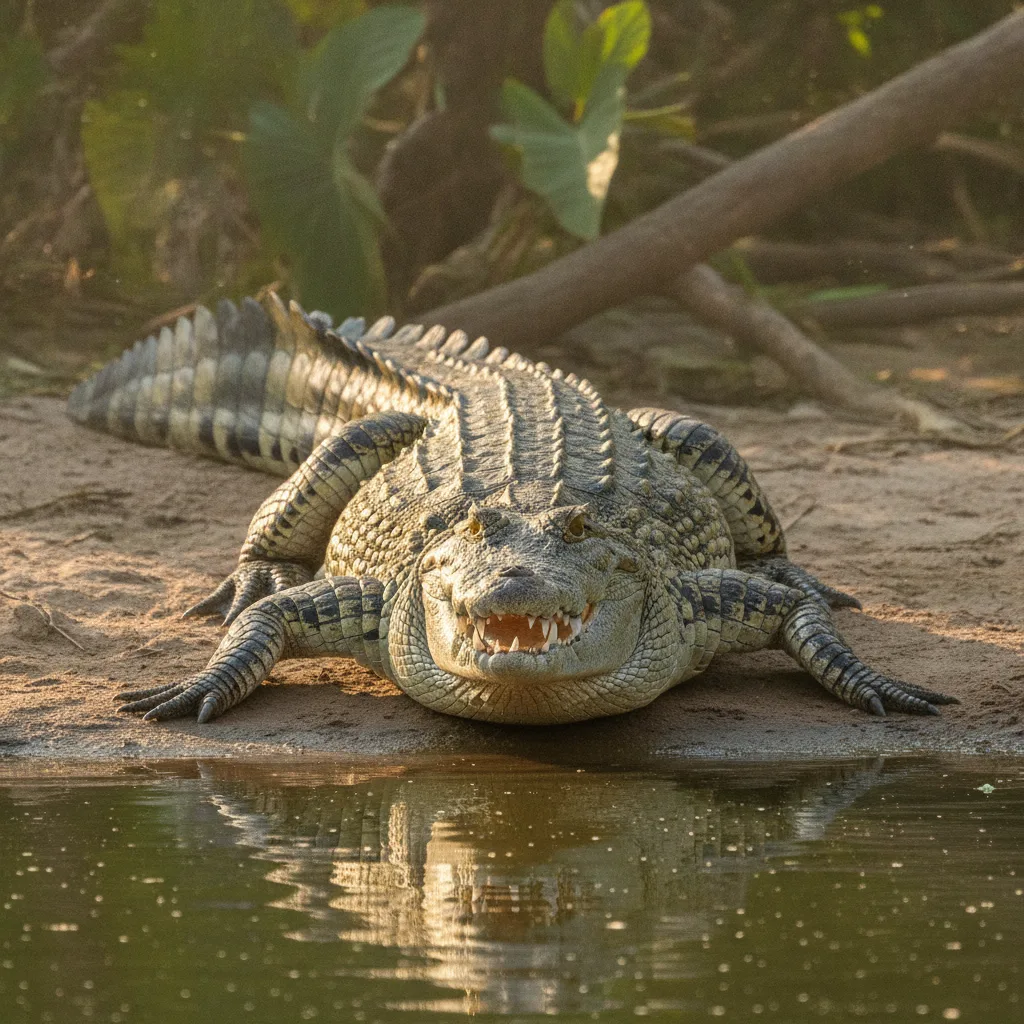
Crocodiles at a glance
| Scientific name | Crocodylidae |
|---|---|
| IUCN status | Varies by species; most are Least Concern or Vulnerable, with several Critically Endangered |
| Population | Approx. 200,000-300,000 (wild, all species combined) |
| Population trend | decreasing |
| Weight | 500–2000 kg |
| Length | 4–7 m |
| Lifespan | 45–100 years |
| Top speed | 24 km/h |
| Class | Reptilia |
| Order | Crocodylia |
| Family | Crocodylidae |
| Known species | 16 |
Need to know
- Crocodiles appeared about 83 million years ago and have changed little since.
- The Saltwater Crocodile is the largest living reptile, with individuals exceeding 6 meters.
- Crocodiles can gallop on land at short bursts up to 24 km/h.
- Crocodiles have the strongest bite recorded among animals—over 3,500 psi in large species.
- Crocodiles are known for their parental care, guarding nests and helping hatchlings to water.
- Some crocodile species are among the most endangered reptiles on Earth.
About the Crocodiles
Crocodiles are large, semi-aquatic reptiles belonging to the family Crocodylidae. They are distinguished by their elongated bodies, powerful tails, robust jaws, and armored skin. With a lineage stretching back to the age of dinosaurs, crocodiles are sometimes called 'living fossils.' They thrive in freshwater and brackish habitats throughout the tropics, though a few species, like the Saltwater Crocodile, can be found in coastal marine environments as well.
Crocodiles are apex predators with highly evolved senses and stealth hunting skills. They are powerful swimmers, using their muscular tails for propulsion, and are capable of surprising bursts of speed on land. Crocodiles are also known for their unique method of caring for young, with mothers fiercely protecting both eggs and hatchlings against predators.
Physical characteristics
Size: 2–7 meters (depending on species). Weight: 80–2,000 kg. Lifespan: Average 45 years, some individuals may reach 80–100 years.
- Armored, scaly skin with osteoderms (bony plates)
- Long, powerful tail for swimming and defense
- Prominent external nostrils and eyes set atop the head
- Conical, interlocking teeth
- Large muscular jaws with extreme bite force
Notable species
- Saltwater Crocodile (Crocodylus porosus) — Least Concern. Coastal brackish and freshwater rivers, estuaries, mangroves Regions: Indian Ocean, Pacific Ocean, coastal waters of northern Australia, Southeast Asia, Borneo, Papua New Guinea.
- Nile Crocodile (Crocodylus niloticus) — Least Concern. Rivers, lakes, marshes, freshwater swamps Regions: East Africa, Central Africa, West Africa, Madagascar, Southern Africa, Nile River.
- American Crocodile (Crocodylus acutus) — Vulnerable. Coastal wetlands, estuaries, mangroves, river mouths Regions: Caribbean Sea, Central America, northern South America, southern Florida, Pacific coasts of Central America, Greater Antilles.
- Mugger Crocodile (Crocodylus palustris) — Vulnerable. Lakes, rivers, marshes, man-made reservoirs Regions: Indian Subcontinent, Sri Lanka, Nepal, Pakistan, Iran.
- Philippine Crocodile (Crocodylus mindorensis) — Critically Endangered. Freshwater rivers, marshes, small lakes Regions: Philippine Islands (Mindanao, Luzon), Visayan Islands.
- Orinoco Crocodile (Crocodylus intermedius) — Critically Endangered. Large rivers, seasonal floodplains, lagoons Regions: Orinoco River, Venezuela, Colombia.
Habitat and range
Original range: Tropical rivers, swamps, and coastal wetlands of Africa, Asia, the Americas, and Australasia
Current distribution: Mainly tropical and subtropical regions of Africa, Asia, Americas, and Australasia, with some populations in brackish coastal waters
Preferred environments: Rivers, Lakes, Marshes, Mangrove swamps, Estuaries, Floodplains, Coastal lagoons
Regions: Nile River, Indian Subcontinent, East Africa, Southeast Asia, Pacific Ocean (coastal areas and islands), Caribbean Sea, Orinoco River, Northern Australia, Madagascar, Central America, Greater Antilles
Where to see Crocodiles
- Kakadu National Park, Northern Australia — May to October (dry season). Best viewing for Saltwater Crocodiles in natural billabongs and rivers, take a guided boat tour for safety
- Chobe River, Botswana — July to October. Spot Nile Crocodiles basking on riverbanks during boat safaris
- Everglades National Park, Florida, USA — December to April. Look for American Crocodiles in brackish coastal areas and canals
Behavior and diet
Diet: Carnivorous; eats fish, birds, reptiles, amphibians, and mammals, including large prey such as antelope or water buffalo for larger species.
Social structure: Mostly solitary except during breeding or in basking congregations; territorial males defend prime habitat.
Communication: Crocodiles vocalize with bellows, growls, hisses, and grunts; hatchlings often chirp to signal readiness to emerge; use low-frequency sounds to communicate, especially during mating.
- Mothers assist hatchlings by carrying them in their mouths to water.
- Practice thermoregulation by basking in the sun or submerging to cool down.
- Can remain submerged without breathing for more than an hour due to efficient oxygen storage.
- Perform 'death roll' to dismember prey
Interactions with other animals
- Fish (prey): Crocodiles eat fish as a staple food source, often ambushing them at water's edge.
- Large Mammals (zebra, wildebeest, water buffalo) (prey): Nile and Saltwater Crocodiles ambush large mammals at river crossings.
- Birds (e.g., plovers) (potential symbiosis): Some birds have been observed cleaning crocodile teeth, though this is rare and debated among scientists.
- Humans (competitive/predator): Crocodiles can prey on humans, but human activities such as hunting, habitat destruction, and pollution are a major threat to croc populations.
Conservation
IUCN Red List status: Varies by species; most are Least Concern or Vulnerable, with several Critically Endangered
Threats
- Habitat loss and degradation
- Illegal hunting and poaching for skin and meat
- Human-crocodile conflict
- Pollution and environmental contamination
- Climate change altering habitat suitability
Conservation efforts
- International trade regulation under CITES Appendix I or II
- Protected reserves and sanctuaries
- Community-based conservation programs
- Breeding and reintroduction programs for critically endangered species
- Education to reduce human-wildlife conflict
How to help
- Support and visit crocodile conservation organizations
- Advocate for wetland and river preservation
- Report illegal hunting or trade of crocodiles
- Promote coexistence and safe practices in croc-inhabited areas
- Educate others about crocodile importance and conservation status
Crocodiles facts for kids
Crocodiles are ancient reptiles that live in rivers, lakes, and swamps in warm parts of the world. They have long jaws filled with sharp teeth and are excellent swimmers. Some crocodiles grow to be longer than a car!
- Crocodiles can stay underwater for over an hour without coming up for air.
- Mother crocodiles help their babies hatch by gently rolling eggs in their mouths.
- Crocodile eyes glow orange or red at night!
- Some crocodiles can jump out of the water to catch food.
- Crocodiles are one of the oldest types of animals alive today—they lived with the dinosaurs!
Did you know? Did you know? The Saltwater Crocodile is so strong it can bite down with ten times more force than a lion!
Watch & learn
- Crocodile Power: Deadly River Predators Documentary — BBC Earth. Experience the thrilling hunt, survival strategies, and ancient lineage of true Crocodylidae as BBC Earth follows freshwater and saltwater crocodiles in the wild. This documentary combines dramatic footage with expert narration to reveal what makes crocodiles such formidable reptiles.
- Inside the Crocodile’s World: Nile Giants and Survival Tactics — National Geographic Wild. Discover the lives of Nile crocodiles and their relatives, exploring their behavior, ecosystems, and interactions with prey and people. National Geographic brings stunning visuals and science-based storytelling for reptile enthusiasts.
- Ultimate Crocodile: Apex Reptile of the Swamp — Smithsonian Channel. Smithsonian Channel delivers unforgettable scenes of saltwater and freshwater crocodiles in their native habitats, featuring in-depth research on Crocodylidae hunting, nesting, and survival adaptations.
- Living With Crocodiles: Nature’s Ancient Predators — PBS Nature. Explore the evolutionary success of Crocodylidae, how communities interact with them today, and the global efforts to conserve these remarkable reptiles. PBS Nature blends wildlife storytelling and conservation insights.
- Crocodile Kingdom: Evolution, Behavior, and Survival — Nat Geo WILD. Nat Geo WILD uncovers the mysterious world of Crocodylidae, investigating their evolutionary roots, unique adaptations, and the danger—and fascination—they inspire across continents.
Sources
Facts on this page are checked against these references. Follow them for the primary data.
- IUCN Red List — Conservation status, population trend and range assessment for Crocodylidae
- Encyclopaedia Britannica — Reviewed encyclopaedia entry on the crocodiles
- National Geographic — Articles, photographs and field reporting on the crocodiles