Asian Elephant
Elephas maximus
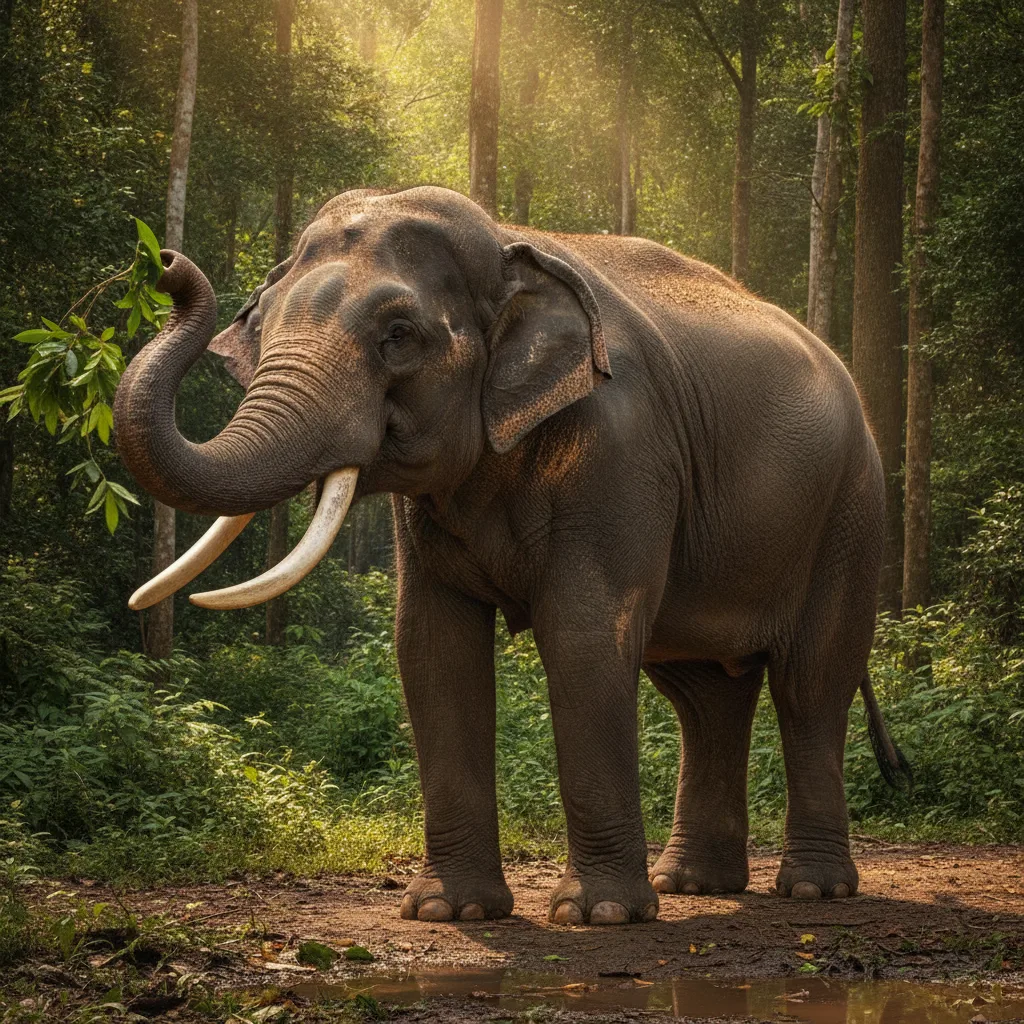
Asian elephants live in the forests and grasslands of 13 countries from India to Borneo, and they are smaller than their African cousins, with smaller, rounded ears and a single finger-like tip on the trunk. Only some males grow tusks, and females have none or very small ones. Fewer than 50,000 remain in the wild across a shrinking, fragmented range, and the species is Endangered.
Quick facts: Size 5.5 - 6.4 meters long, 2 - 3.5 meters tall · Lifespan up to 60 years in the wild · IUCN status Endangered
Print the fact sheet — a free one-page PDF for homeschool and classroom use
Asian Elephant at a glance
| Scientific name | Elephas maximus |
|---|---|
| IUCN status | Endangered |
| Population | 40,000 - 50,000 |
| Population trend | decreasing |
| Weight | 4000–5400 kg |
| Length | 5.5–6.4 m |
| Lifespan | 48–60 years |
| Top speed | 25 km/h |
| Class | Mammalia |
| Order | Proboscidea |
| Family | Elephantidae |
Need to know
- The Asian elephant is the largest land mammal in Asia.
- Unlike African elephants, only some male Asian elephants have large visible tusks.
- They have finger-like dexterity at the end of their trunk, but only one ‘finger’ tip on each side.
- Asian elephants form complex, matriarch-led social groups called herds.
- Their populations are severely threatened by habitat loss, fragmentation, and human-elephant conflict.
- They play a key ecological role by dispersing seeds and creating clearings in dense forests.
About the Asian Elephant
The Asian elephant (Elephas maximus) is an iconic species of the forests and grasslands of South and Southeast Asia. These massive herbivores are renowned for their intelligence, strong social bonds, and central role in Asian culture and ecology. While the species was once widespread from the Tigris-Euphrates Valley across Southeast Asia to China, their range and numbers have declined sharply due to hunting, poaching, and especially habitat loss.
Recognized as the largest land mammal in Asia, Asian elephants are easily distinguishable by their smaller ears (compared to African elephants), high-domed heads, and a single “finger” at the tip of their trunk. Today, the surviving populations are scattered and isolated, with localized subspecies showing unique adaptations to their island or mainland environments.
Despite dangerous declines, Asian elephants remain a keystone species, shaping their ecosystems by breaking trees, dispersing seeds, and maintaining forest clearings, which benefits many other species.
Physical characteristics
Size: 5.5 - 6.4 meters long, 2 - 3.5 meters tall. Weight: 2,500 - 5,400 kg. Lifespan: up to 60 years in the wild.
- Smaller, rounded ears compared to African elephants
- Large, domed head with twin domes
- Trunk with a single finger-like projection at the tip
- Partial or absent tusks in many individuals
- Wrinkled grey skin with occasional pinkish spots
Notable species
- Indian Elephant (Elephas maximus indicus) — Endangered. Varied forests (tropical, dry, and moist forests), grasslands, scrublands Regions: India, Nepal, Bangladesh, Bhutan, Southeast Asia, Myanmar, Thailand.
- Sri Lankan Elephant (Elephas maximus maximus) — Endangered. Dry and moist lowland forests, grasslands Regions: Sri Lanka.
- Sumatran Elephant (Elephas maximus sumatranus) — Critically Endangered. Lowland and hill dipterocarp forests, peat swamp forests Regions: Sumatra (Indonesia).
- Borneo Elephant (Bornean Pygmy Elephant) (Elephas maximus borneensis) — Endangered. Lowland rainforests, river valleys, floodplains Regions: Borneo (Sabah, Malaysia), Borneo (Kalimantan, Indonesia).
Habitat and range
Original range: From the Tigris-Euphrates Valley in West Asia eastward through the Indian subcontinent to Southeast Asia and southern China.
Current distribution: Now fragmented and reduced to isolated populations in India, Sri Lanka, Nepal, Bangladesh, Bhutan, Myanmar, Thailand, Laos, Cambodia, Vietnam, Peninsular Malaysia, Sumatra, and Borneo.
Preferred environments: Tropical moist forests, Dry deciduous forests, Grasslands, Scrub forests, Flooded forests
Regions: India, Nepal, Bangladesh, Sri Lanka, Myanmar, Thailand, Laos, Cambodia, Vietnam, Peninsular Malaysia, Sumatra, Borneo
Where to see Asian Elephant
- Kaziranga National Park, India — November to April. Famous for large herds, especially during the dry season.
- Udawalawe National Park, Sri Lanka — Year-round, especially in dry season (May to September). Excellent viewing due to reliable water sources.
- Gunung Leuser National Park, Sumatra — June to September. Best chance to see rare Sumatran elephants.
- Tabin Wildlife Reserve, Sabah, Borneo — March to October. Observe Bornean elephants in lowland rainforest.
Behavior and diet
Diet: Asian elephants are herbivores, feeding on grasses, leaves, bark, roots, fruits, and cultivated crops.
Social structure: They live in matriarchal herds led by an older female, with related females and their offspring. Adult males are usually solitary or form loose bachelor groups.
Communication: They use a combination of low-frequency rumbles (including infrasound), trumpets, roars, and touch, as well as visual signals.
- Use trunks to spray water or dust for cooling and protection
- Create and use tools such as sticks or branches for scratching
- Show strong empathy—will comfort distressed herd members
- Remember routes, water sources, and social relationships for decades
Interactions with other animals
- Tiger (predator): Occasional predation on calves by tigers, primarily in India and Southeast Asia.
- Humans (competitive): Human-elephant conflict over crops and habitat causes injury and death to both.
- Termites (symbiotic): Elephants open up forests and create deadwood habitats for termites and other insects.
Conservation
IUCN Red List status: Endangered
Threats
- Habitat loss and fragmentation
- Poaching for ivory, skin, and other body parts
- Human-elephant conflict
- Degradation of migration corridors
- Capture for tourism and logging industries
Conservation efforts
- Creation and enforcement of protected areas
- Anti-poaching patrols and surveillance
- Community-based conflict mitigation programs
- Restoration of migration corridors
- International legal protection (CITES Appendix I)
How to help
- Support trusted wildlife conservation organizations
- Promote responsible ecotourism that benefits local communities
- Avoid purchasing ivory or elephant-derived products
- Help raise awareness about elephant conservation
- Advocate for habitat protection and wildlife corridor restoration
Asian Elephant facts for kids
Asian elephants are huge, gentle animals with trunks like a built-in hose and big, floppy ears. They live in family herds led by moms and can live up to 60 years. Sadly, they're endangered and need our help to survive.
- Baby elephants are called calves.
- Elephants use their trunks to grab things, make sounds, and squirt water.
- Most Asian elephants don't have big tusks—only some males do.
- They make low rumbles that people can't even hear.
- Elephants can be left or right 'tusked,' using one tusk more than the other.
Did you know? Did you know? An Asian elephant's trunk has more than 40,000 muscles, making it one of the most amazing tools in the animal kingdom!
Watch & learn
- The Secret Life of Asian Elephants – Stunning Wild Footage — BBC Earth. This documentary explores the behavior, social structures, and conservation challenges of Asian elephants in their natural habitats, with breathtaking visuals and expert narration. BBC Earth's cinematography and insights make this a must-watch for understanding Elephas maximus.
- Asian Elephant Calves: Family Bonds in the Wild — Smithsonian Channel. Smithsonian Channel dives into the familial bonds of Asian elephant mothers and calves, showing how they navigate daily survival and face unique jungle threats. Great for those interested in animal intelligences and social structures.
- Epic Journeys of Asian Elephants – India’s Giants — National Geographic Wild. Follow wild Asian elephants through India’s forests as National Geographic documents their epic migrations, water-crossings, and the perils they face from habitat loss. Stunning storytelling and high production values.
- Asian Elephant Stories: Conservation and Human Conflict — PBS Nature. PBS Nature presents a compelling look at how Elephas maximus navigates the encroachment of humans into their territories, highlighting both conflict and successful conservation efforts. Ideal for viewers interested in real-world wildlife issues.
- Guardians of the Forest: Asian Elephants in Sri Lanka — Nat Geo WILD. Discover how Asian elephants shape their environments and the unique conservation projects underway in Sri Lanka. This Nat Geo WILD segment showcases both beauty and urgency in preserving a threatened species.
Sources
Facts on this page are checked against these references. Follow them for the primary data.
- IUCN Red List — Conservation status, population trend and range assessment for Elephas maximus
- Encyclopaedia Britannica — Reviewed encyclopaedia entry on the asian elephant
- National Geographic — Articles, photographs and field reporting on the asian elephant