African Elephant
Loxodonta
African elephants — the savanna species and the smaller forest species — range across 37 countries south of the Sahara and are the largest animals on land, with savanna bulls topping 6 tonnes. Their ears radiate heat, and family herds follow a matriarch whose memory of distant water sources can span decades. The savanna elephant is Endangered and the forest elephant Critically Endangered, with poaching for ivory the leading cause.
Quick facts: Size 2.7-4.0 m tall at the shoulder, 6-7.5 m body length for savanna; 2.0-2.6 m tall, 4-5 m body length for forest elephants · Lifespan On average 60 years in the wild · IUCN status Endangered
Print the fact sheet — a free one-page PDF for homeschool and classroom use
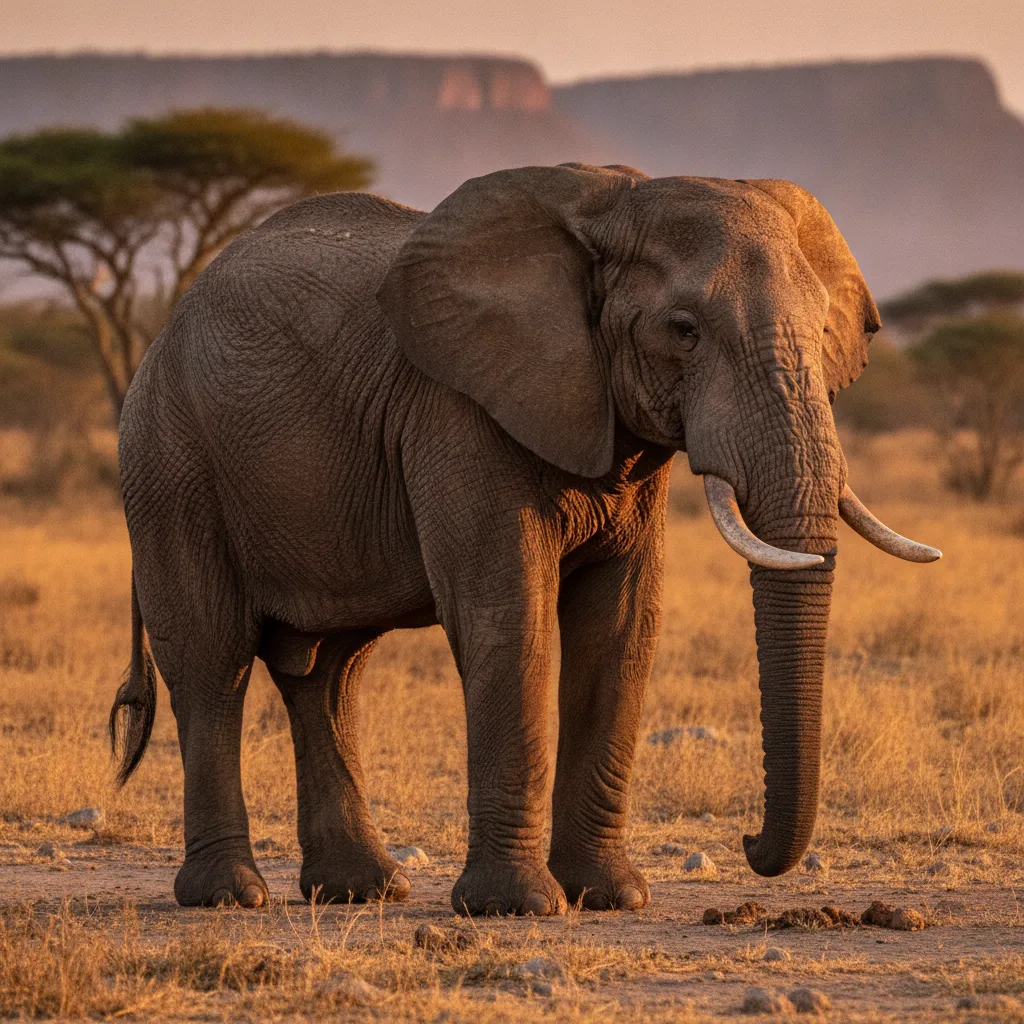
African Elephant at a glance
| Scientific name | Loxodonta |
|---|---|
| IUCN status | Endangered |
| Population | 415,000 - 500,000 |
| Population trend | decreasing |
| Weight | 4500–12000 kg |
| Length | 3.2–4 m |
| Lifespan | 60–74 years |
| Top speed | 40 km/h |
| Class | Mammalia |
| Order | Proboscidea |
| Family | Elephantidae |
| Known species | 2 |
Need to know
- African elephants are the largest land mammals alive today.
- Their large ears help them dissipate heat in the African sun.
- Each elephant’s tusks are unique and grow continuously throughout life.
- Elephants communicate with low-frequency sounds undetectable to humans.
- Females live in matriarchal herds led by an older matriarch.
- Forest elephants are now recognized as a distinct and critically endangered species.
About the African Elephant
African elephants are the gigantic, gentle giants of Africa, renowned for their intelligence, complex social lives, and iconic appearance. Historically widespread across nearly all sub-Saharan ecosystems, African elephants are keystone species—shaping their environments by creating waterholes, dispersing seeds, and modifying landscapes. Modern science now recognizes two distinct African elephant species: the Savanna (Bush) Elephant, which roams the continent’s grasslands and open woodlands, and the smaller, elusive Forest Elephant, which inhabits the dense rainforests of Central and West Africa.
Both species have been deeply affected by human activity, especially poaching for ivory and loss of habitat. Despite these threats, elephants continue to display extraordinary resilience, using their immense intelligence and social cooperation to survive. Their complex communication, use of tools, and tight family bonds make them one of the animal kingdom's most fascinating creatures.
Physical characteristics
Size: 2.7-4.0 m tall at the shoulder, 6-7.5 m body length for savanna; 2.0-2.6 m tall, 4-5 m body length for forest elephants. Weight: 3,000–6,000 kg for savanna, 2,000–4,000 kg for forest elephants; extremes up to 12,000 kg. Lifespan: On average 60 years in the wild.
- Long, muscular trunk with fingerlike projections
- Large fan-shaped ears with intricate blood vessel patterns
- Columnar legs supporting immense weight
- Thick, wrinkled gray skin often covered in mud
- Long, curved ivory tusks (larger in savanna elephants, both sexes)
Notable species
- African Savanna Elephant (Loxodonta africana) — Endangered. Savannas, grasslands, woodlands, and deserts Regions: East Africa, Southern Africa, Central Africa, West Africa, Sahel region, Miombo woodlands, Kalahari Basin.
- African Forest Elephant (Loxodonta cyclotis) — Critically Endangered. Dense lowland tropical rainforests Regions: Congo Basin, West African rainforests, Gabon, Cameroon, Republic of the Congo, Central African Republic, Ivory Coast.
Habitat and range
Original range: Sub-Saharan Africa: from the Sahel through East, Central, West, and Southern Africa in nearly all major habitats except deserts and dense mountain forests.
Current distribution: Reduced to fragmented populations in protected reserves and remaining wilderness areas mainly in East, Southern, Central, and a few West African regions.
Preferred environments: Savannas, Grassy plains, Open woodlands, Desert fringes, Tropical rainforests (forest elephant)
Regions: East Africa, Southern Africa, Central Africa, West Africa, Congo Basin, Sahel region, Miombo woodlands, Kalahari Basin, Gabon, Cameroon
Where to see African Elephant
- Serengeti National Park, Tanzania — June to October (dry season). Prime area for viewing large herds of savanna elephants during migration.
- Okavango Delta, Botswana — May to September. Excellent for observing family groups and river crossings.
- Loango National Park, Gabon — June to September. One of the best places for rare sightings of forest elephants.
- Kruger National Park, South Africa — April to September. Well-established viewing infrastructure and large elephant populations.
Behavior and diet
Diet: Herbivorous: grasses, tree bark, leaves, roots, fruit, and occasionally crops.
Social structure: Matrilineal: mostly female-led herds with calves; males leave the herd at adolescence and live solitary or form small bachelor groups.
Communication: Low-frequency infrasound calls (traveling many kilometers), as well as rumbles, trumpets, touch, visual signals, and seismic vibrations.
- Mourning and apparent grieving at the death of herd members
- Tool use, such as using branches to swat flies or dig
- Cooperative childcare—females help rear each other's calves
- Digging for water in dry riverbeds using their tusks and trunks
Interactions with other animals
- Lions (competitive): Lions may prey on elephant calves, especially if they're isolated from the herd.
- Dung beetles (symbiotic): Dung beetles use elephant dung as food and breeding sites, helping decompose waste.
- Baboons (symbiotic): Baboons and other primates sometimes benefit from waterholes created by elephants.
- Humans (competitive): Humans compete with elephants for land and water, and elephants are sadly targeted for their ivory.
Conservation
IUCN Red List status: Endangered
Threats
- Poaching for ivory
- Habitat loss and fragmentation
- Human-wildlife conflict
- Climate change affecting water/food availability
Conservation efforts
- International ivory trade bans (CITES)
- Creation and expansion of protected reserves
- Transfrontier conservation efforts
- Anti-poaching patrols and ranger training
- Community-based conservation programs
How to help
- Support organizations working to stop ivory trade
- Engage with certified eco-tourism supporting local communities
- Advocate for stronger wildlife protection laws
- Reduce personal consumption of products contributing to habitat destruction
- Spread awareness through education and community involvement
African Elephant facts for kids
African elephants are huge, smart animals that live in family groups and use their trunks like hands. They are the largest animals on land and live in the grasslands and forests of Africa. Sadly, they need help because people hunt them for their tusks.
- Elephants can use their trunks to pick up small objects and even paint pictures!
- An elephant’s ears work like air conditioners—they help keep them cool.
- Baby elephants are called calves and can weigh as much as 120 kg at birth.
- Elephants love mud baths to protect their skin from the sun.
- Elephants have great memories—they never forget a friend!
Did you know? Did you know an elephant can drink up to 200 liters of water in a single day using its trunk like a giant straw?
Watch & learn
- The Secrets of African Elephants - Giants of the Savanna — BBC Earth. BBC Earth explores the complex social structures, intelligence, and challenges faced by African elephants in the wild, with stunning savanna footage and expert narration.
- African Elephant Families: Matriarchs and Survival in the Wild — National Geographic Wild. National Geographic Wild dives into the matriarchal societies of Loxodonta africana, revealing intimate moments of elephant family life and their strategies to survive in harsh environments.
- The Incredible Intelligence of African Elephants — Smithsonian Channel. This Smithsonian Channel episode showcases the remarkable memory, empathy, and problem-solving abilities of African elephants through rare wildlife footage and scientific insight.
- African Elephant Trails: Migration and Conservation Drama — PBS Nature. Follow Loxodonta elephants on their epic migratory journeys across Africa, with PBS Nature examining the ecological importance, threats, and ongoing conservation efforts.
- Communication and Social Bonds in African Elephants — BBC Earth. BBC Earth presents an in-depth look at how African elephants use low-frequency calls, touch, and cooperative behavior to maintain complex social networks.
Sources
Facts on this page are checked against these references. Follow them for the primary data.
- IUCN Red List — Conservation status, population trend and range assessment for Loxodonta
- Encyclopaedia Britannica — Reviewed encyclopaedia entry on the african elephant
- National Geographic — Articles, photographs and field reporting on the african elephant