Siberian Tiger
Panthera tigris
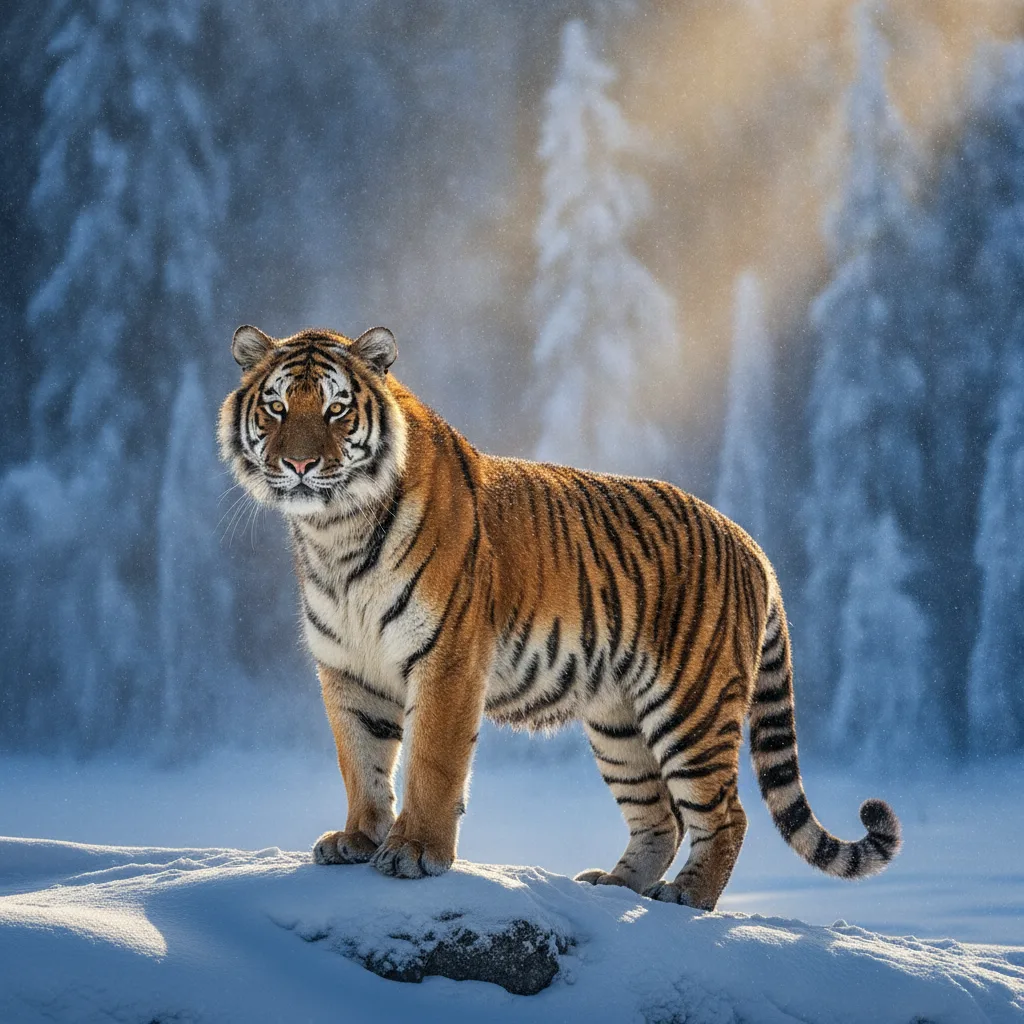
Siberian, or Amur, tigers live in the birch and pine forests of the Russian Far East and a corner of northeast China, where snow covers the ground for months each year. They are the largest tigers, with males over 3 metres long and 200 kilograms, and a single male's territory can exceed 1,000 square kilometres. Fewer than 50 remained in the 1940s; protection has raised the population to roughly 500–600, and the subspecies is Endangered.
Quick facts: Size 2.4 to 3.3 m (head and body length) · Lifespan 10–15 years in the wild, up to 20 in captivity · IUCN status Endangered
Print the fact sheet — a free one-page PDF for homeschool and classroom use
Siberian Tiger at a glance
| Scientific name | Panthera tigris |
|---|---|
| IUCN status | Endangered |
| Population | 500-600 |
| Population trend | increasing |
| Weight | 220–300 kg |
| Length | 2.7–3.3 m |
| Lifespan | 14–20 years |
| Top speed | 65 km/h |
| Class | Mammalia |
| Order | Carnivora |
| Family | Felidae |
| Known species | 6 |
Need to know
- Siberian tigers are the largest wild cats on Earth.
- They have the palest coats and most widely spaced stripes among tigers.
- Historic population lows of ~20 individuals in the 1940s led to urgent conservation efforts.
- Their main prey are large deer and wild boar; a single meal can be 18 kg.
- These tigers can survive extreme winter temperatures of -40°C.
- Each Siberian tiger can roam territories as large as 1,000 km².
About the Siberian Tiger
The Siberian tiger, also known as the Amur tiger, is the largest of all tiger subspecies and one of the most iconic and endangered big cats in the world. Adapted to the cold, harsh environments of the Russian Far East and bordering regions of northeast China, this apex predator once ranged throughout much of eastern Russia, Korea, and northeastern China. Conservation efforts have helped the wild population recover from near-extinction during the mid-20th century, but survival remains precarious due to poaching, habitat loss, and prey depletion.
Siberian tigers are immediately recognizable by their impressive size, thick pale orange coats, and widely spaced, narrow black stripes. Solitary and elusive, they command vast territories and play a crucial role in maintaining the health of their forest ecosystems. Intensive tracking and research have yielded detailed insights into their behavior, movement, and genetics, supporting modern conservation.
Physical characteristics
Size: 2.4 to 3.3 m (head and body length). Weight: 180–306 kg (males), 100–167 kg (females). Lifespan: 10–15 years in the wild, up to 20 in captivity.
- thick pale orange fur with narrow, widely spaced dark stripes
- large head and powerful jaws
- long bushy tail, up to 1 m
- massive forelimbs and large, padded paws
- robust, muscular body adapted for power
Notable species
- Siberian Tiger (Panthera tigris altaica) — Endangered. mixed forests, taiga, and mountainous terrain Regions: Russian Far East, Eastern Siberia, northeast China, Amur-Ussuri region.
- Bengal Tiger (Panthera tigris tigris) — Endangered. tropical and subtropical rainforests, grasslands, mangrove swamps Regions: India, Bangladesh, Nepal, Bhutan, Myanmar.
- Indochinese Tiger (Panthera tigris corbetti) — Endangered. forests in mountainous and hilly terrain Regions: Cambodia, Vietnam, Thailand, Myanmar, Laos.
- Malayan Tiger (Panthera tigris jacksoni) — Critically Endangered. tropical and subtropical broadleaf forests Regions: Malay Peninsula, Taman Negara, Central Malaysia, southern Thailand.
- South China Tiger (Panthera tigris amoyensis) — Critically Endangered (Possibly Extinct in Wild). subtropical evergreen forests Regions: South China, Guangdong Province, Fujian Province.
- Sumatran Tiger (Panthera tigris sumatrae) — Critically Endangered. dense lowland and montane forests Regions: Sumatra, Bukit Barisan, Leuser Ecosystem, Kerinci Seblat National Park.
Habitat and range
Original range: Eastern Russia (Siberia), the Korean Peninsula, northeast China, and historically Mongolia and the Russian Far East
Current distribution: Primarily the Russian Far East (Amur-Ussuri region), with small numbers in northeast China and possibly occasional vagrant individuals reaching North Korea.
Preferred environments: mixed coniferous-deciduous forests, taiga, mountainous forests, river valleys
Regions: Russian Far East, Amur-Ussuri region, Sikhote-Alin Mountains, Eastern Siberia, northeast China (Jilin and Heilongjiang provinces)
Where to see Siberian Tiger
- Sikhote-Alin Biosphere Reserve, Russian Far East — Winter (December–March). Best chance of tracks in snow; guided tracking tours available
- Hunchun National Nature Reserve, Jilin, China — Late winter to early spring. Remote camera traps and guided expeditions for rare sightings
Behavior and diet
Diet: Primarily large ungulates such as red deer, sika deer, roe deer, and wild boar; also occasionally small mammals and birds.
Social structure: Solitary except females with cubs; each adult maintains and defends a large home range, with males' territories overlapping those of several females.
Communication: Uses scent marking, scratch marks, roars, chuffing, growls, and body postures to communicate territory and mood.
- Can swim across large rivers and fish in shallow waters during summer.
- May cache uneaten prey and cover it with foliage for days.
- Cubs stay with their mother for up to two years, learning to hunt.
- Frequently patrolling and scent marking territory boundaries.
Interactions with other animals
- Brown bear (competitive): Tigers and bears compete for prey, and rare confrontations occur; tigers may kill brown bears for food.
- Red deer (prey): Red deer are a primary prey species for Siberian tigers.
- Gray wolf (competitive): Wolves and tigers compete for prey; tigers may displace wolf packs in overlapping territories.
Conservation
IUCN Red List status: Endangered
Threats
- poaching (for fur and body parts)
- illegal hunting of prey species
- habitat loss and fragmentation
- human-wildlife conflict
- encroachment by logging and infrastructure
Conservation efforts
- joint Russia-China anti-poaching patrols
- protected areas and tiger reserves
- community education and compensation programs
- radio-collar tracking and population monitoring
- prey population restoration and rewilding projects
How to help
- Support reputable tiger conservation charities (WWF, WCS, Panthera, etc.)
- Promote responsible, sustainable forest product use
- Raise awareness about the illegal wildlife trade
- Encourage governments to enforce anti-poaching laws
- Contribute to organizations funding anti-poaching patrols and camera trap monitoring
Siberian Tiger facts for kids
Siberian tigers are the biggest wild cats in the world and live in the cold forests of Russia and northern China. They are solitary hunters with beautiful orange fur and black stripes. There are very few left in the wild, so people are working hard to help them survive.
- A Siberian tiger's roar can be heard over 2 miles away!
- No two tigers have the same stripe pattern—like our fingerprints.
- They have big, fluffy fur to keep warm in the snow.
- Siberian tigers can eat up to 40 pounds of meat in one meal.
- Baby tigers are called cubs and live with their mom for about two years.
Did you know? Did you know that a Siberian tiger's pawprint is as big as a grown-up's hand?
Watch & learn
- The Secret World of Siberian Tigers — BBC Earth. Follows the hidden lives of Panthera tigris in the remote forests of Siberia, using extraordinary camera work and rare footage to showcase their behavior and survival challenges.
- Surviving Siberia: Tigers of the Snow — PBS Nature. This documentary offers stunning insight into the ecology of the Siberian Tiger, their prey, and the harsh winter landscape, with a strong conservation perspective.
- The Last Giants: Siberian Tigers in the Wild — National Geographic Wild. Examines the challenges facing the largest tiger subspecies, spotlighting conservationists’ and scientists’ efforts to protect Panthera tigris from extinction.
- Siberian Tigers: Lost in the Taiga — Smithsonian Channel. Explores the elusive nature of the Siberian Tiger through remarkable field footage and research stories from the Russian Far East.
- Winter Warriors: The Siberian Tiger’s Struggle — BBC Earth. Delves into how Siberian Tigers survive the frigid winters, following an individual tiger’s hunt and territory patrol in the snowy wilderness.
Sources
Facts on this page are checked against these references. Follow them for the primary data.
- IUCN Red List — Conservation status, population trend and range assessment for Panthera tigris
- Encyclopaedia Britannica — Reviewed encyclopaedia entry on the siberian tiger
- National Geographic — Articles, photographs and field reporting on the siberian tiger